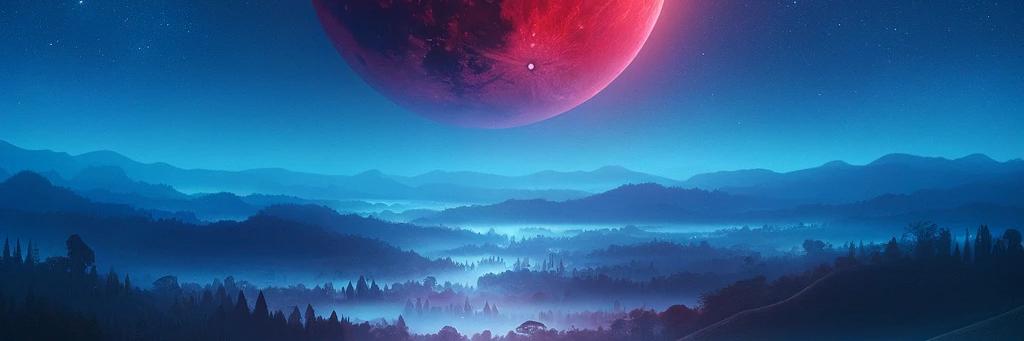
The Crimson Moon, a celestial marvel that captivates minds and inspires awe, has woven itself into the fabric of human culture and history. Its scarlet glow paints the night sky, leaving observers transfixed. In this article, we delve into the various aspects of this enigmatic phenomenon, exploring its mythology, scientific explanations, cultural significance, and artistic interpretations. Join us on a journey to the land of the Crimson Moon.
The Mythology Behind the Crimson Moon
Throughout history, numerous civilizations have crafted intricate tales about the origins and nature of the Crimson Moon. Ancient myths speak of gods and goddesses who governed the celestial bodies, attributing the fiery red hue of the moon to divine intervention.
In one such myth, the Crimson Moon was believed to be the chariot of the god of war, a celestial vessel that carried him across the night sky. It was said that the red color of the moon represented the bloodshed and violence that accompanied the god's presence.
Another myth tells of a goddess who was banished to the moon as punishment for her arrogance. The Crimson Moon was said to be a constant reminder of her exile, forever glowing with her fiery anger and longing for redemption.
Some cultures believed that the red moon marked a time of great change or impending doom. It was seen as a harbinger of war, famine, or natural disasters. People would anxiously await its appearance, seeking signs and omens in its fiery glow.
These stories, passed down through generations, shaped the perception and fascination surrounding the Crimson Moon. They were not merely tales to entertain, but attempts to make sense of the world and its celestial wonders.
While these myths may seem fantastical, they reflect humanity's desire to understand and interpret the world around them. The Crimson Moon, with its mysterious allure, invites imagination and speculation.
Beyond the myths, astronomers have also studied the Crimson Moon, seeking scientific explanations for its unique color. One theory suggests that the reddish hue is caused by the scattering of sunlight through the Earth's atmosphere during a lunar eclipse. The Earth's atmosphere filters out most of the blue and green light, allowing only the red wavelengths to reach the moon's surface.
Another theory proposes that the Crimson Moon's color is a result of the moon's composition. It is believed that the presence of certain minerals on the moon's surface, such as iron oxide or volcanic ash, could give it a reddish tint when illuminated by the sun.
Despite these scientific explanations, the allure of the Crimson Moon continues to captivate the human imagination. Artists and poets have been inspired by its fiery beauty, depicting it in paintings, literature, and music. Its symbolism has found its way into various cultures and artistic expressions, representing passion, transformation, and the mysterious forces of the universe.
Whether viewed through the lens of mythology or science, the Crimson Moon remains a celestial enigma, a symbol of wonder and intrigue that has fascinated humanity for centuries.
Natural Phenomena: The Blood Moon Explained
What causes the Crimson Moon to illuminate the night sky in such a striking hue? The answer lies in a celestial dance of heavenly bodies. A total lunar eclipse, often referred to as a Blood Moon, occurs when Earth aligns perfectly between the Sun and the Moon, casting a shadow on its surface.
During this eclipse, the Earth's atmosphere scatters sunlight, filtering out the shorter blue and green wavelengths while allowing the longer red wavelengths to reach the Moon. As a result, the lunar surface appears bathed in a reddish glow, captivating observers around the world.
Imagine standing outside on a clear night, gazing up at the sky. The moon, usually a radiant white or silver, begins to darken as the Earth's shadow slowly engulfs it. As the eclipse progresses, the moon takes on an eerie red hue, resembling a celestial ember suspended in the vast expanse of the universe.
But what exactly causes the Earth's atmosphere to scatter sunlight in such a way? The answer lies in the phenomenon known as Rayleigh scattering. When sunlight enters the Earth's atmosphere, it interacts with the molecules and particles present, causing the light to scatter in different directions. The shorter wavelengths, such as blue and green, are scattered more easily, while the longer wavelengths, like red, are able to travel through the atmosphere with less obstruction.
As the Earth aligns perfectly between the Sun and the Moon, the Moon enters the Earth's shadow, known as the umbra. The umbra is not completely dark but is instead bathed in a faint reddish glow. This glow is a result of sunlight passing through the Earth's atmosphere and bending around its curved surface. The atmosphere acts like a lens, refracting the light and directing it towards the Moon.
Interestingly, the intensity of the red glow can vary from one Blood Moon to another. Factors such as the Earth's atmospheric conditions, including the presence of dust, pollution, and volcanic ash, can influence the color and brightness of the lunar eclipse. In some cases, the Moon may appear more coppery or even a deep shade of red, creating a truly mesmerizing spectacle in the night sky.
Throughout history, cultures around the world have attributed various meanings and significance to the Blood Moon. Some view it as a mystical event, a sign of impending change or a time of spiritual reflection. Others see it as a reminder of the vastness and beauty of the universe, a humbling experience that connects us to something greater than ourselves.
As the Blood Moon graces the night sky, it serves as a reminder of the intricate and awe-inspiring nature of our universe. It invites us to pause, to marvel at the celestial ballet unfolding above us, and to contemplate our place in the grand tapestry of existence.
Cultural Significance of Red Moons
For cultures throughout history, the Crimson Moon holds deep cultural significance. In some societies, it is seen as a symbol of fertility or a harbinger of abundance. The vibrant red hue of the moon is believed to represent the life-giving properties of blood, connecting it to the cycles of nature and the creation of new life. This association with fertility has led to rituals and ceremonies centered around the Crimson Moon, where couples seeking to conceive gather under its mesmerizing glow, hoping to receive its blessings.
Others consider the Red Moon to be a celestial guardian, watching over the world during the night. In ancient folklore, it is believed that the Crimson Moon has the power to ward off evil spirits and protect the land from harm. This belief has given rise to the practice of hanging red lanterns or lighting bonfires during nights when the moon turns red. These rituals are seen as a way to honor and seek the protection of the moon's benevolent presence.
Additionally, certain religious and spiritual traditions associate the Crimson Moon with important festivals or rituals. In some cultures, the appearance of a Red Moon marks the beginning of a sacred period, during which devotees engage in fasting, prayer, and meditation. The moon's fiery color is believed to enhance the spiritual energy and facilitate a deeper connection with the divine. During these times, temples and sacred sites are adorned with red decorations, and special ceremonies are conducted to honor the moon's unique radiance.
This captivating lunar spectacle continues to shape celebrations and traditions, integrating itself into the tapestry of various cultures. In some regions, the Red Moon is considered an omen, signaling significant events such as the birth of a great leader or the onset of a prosperous era. Astrologers and fortune-tellers study the patterns of the Crimson Moon, interpreting its appearance and movements to predict the future and guide decision-making.
Furthermore, artists and poets have long been inspired by the beauty and mystique of the Red Moon. Its rare occurrence and striking color have been the subject of countless paintings, sculptures, and literary works. The moon's ethereal glow and the emotions it evokes have been captured in poems, songs, and stories, immortalizing its allure in the hearts and minds of people across generations.
Scientific Perspectives on the Crimson Moon
While ancient tales and cultural beliefs have given the Crimson Moon a mystical aura, scientific explanations offer insights into its true nature. Scientists and astronomers have extensively studied lunar eclipses to unravel the secrets behind this celestial dance.
Through meticulous observations and measurements, researchers have expanded our understanding of the laws governing the cosmos. These scientific perspectives shed light on the mechanics of the crimson hue and unveil the veil of mystery that shrouded the phenomenon for centuries.
One fascinating aspect of the scientific study of lunar eclipses is the examination of the Earth's atmosphere. As the Moon passes through the Earth's shadow, the sunlight refracts and scatters, causing the Moon to appear red. This phenomenon, known as Rayleigh scattering, is the same process that gives the sky its blue color during the day. However, during a lunar eclipse, the longer wavelengths of light, such as red and orange, are able to pass through the Earth's atmosphere and reach the Moon, creating the captivating crimson hue.
Scientists have also delved into the historical records of lunar eclipses, dating back centuries, to gain a deeper understanding of the Crimson Moon. By analyzing these records, researchers have been able to identify patterns and predict future eclipses with remarkable accuracy. This knowledge has not only advanced our understanding of the celestial mechanics involved but has also allowed for the planning and observation of rare and significant astronomical events.
Furthermore, the study of lunar eclipses has provided valuable insights into the composition and structure of the Moon itself. During an eclipse, scientists can analyze the light passing through the Earth's atmosphere and use spectroscopy to determine the elements present on the lunar surface. This information helps in unraveling the Moon's geological history and understanding its formation and evolution over billions of years.
Another intriguing aspect of the scientific investigation into the Crimson Moon is the exploration of its cultural significance across different civilizations. By studying ancient texts, artwork, and folklore, scientists have been able to trace the beliefs and rituals associated with lunar eclipses throughout history. This interdisciplinary approach not only enriches our understanding of the phenomenon but also provides valuable insights into the cultural and societal aspects of human civilization.
In conclusion, scientific perspectives on the Crimson Moon have revealed a wealth of knowledge about this celestial phenomenon. By studying lunar eclipses, scientists have unraveled the mechanics behind the crimson hue, analyzed the Earth's atmosphere, explored the Moon's composition, and delved into its cultural significance. These scientific endeavors continue to expand our understanding of the cosmos and deepen our appreciation for the wonders of the universe.
The Crimson Moon in Art and Literature
The captivating allure of the Crimson Moon has found its way into the realm of human creativity. Artists and writers, inspired by its rare brilliance, have woven its image into their works.
Poets have penned verses about the enchanting glow of the red moon, while painters have captured its beauty on canvas. From ancient scrolls to masterful symphonies, the Crimson Moon has influenced the creation of countless artworks. Its presence in art and literature serves as a testament to both its visual splendor and its profound impact on human expression.
Imagine a moonlit night, where the sky is painted in shades of deep purple and indigo. The Crimson Moon hangs low, casting a mesmerizing glow that bathes the world below. The air is thick with anticipation, as if the moon itself holds secrets waiting to be revealed. It is in this mystical atmosphere that artists and writers find their inspiration.
In the realm of poetry, the Crimson Moon has been a muse for countless bards throughout history. They have crafted verses that speak of its ethereal beauty and the emotions it evokes. Lines of poetry dance across the pages, capturing the essence of the moon's scarlet radiance. Each word carefully chosen to convey the sense of wonder and enchantment that the Crimson Moon brings to the night sky.
Meanwhile, painters have sought to recreate the Crimson Moon's allure on canvas. With delicate brushstrokes and vibrant pigments, they bring to life the moon's fiery glow. The canvas becomes a portal to a world where reality and imagination intertwine. The artists' interpretation of the Crimson Moon varies, from abstract representations to detailed landscapes, each capturing a unique perspective of its captivating presence.
Not limited to the visual arts, the Crimson Moon has also inspired composers to create symphonies that echo its mystical aura. The haunting melodies and dramatic crescendos mirror the moon's ever-changing phases. The music transports listeners to a realm where time stands still, and the Crimson Moon reigns supreme. It is a symphony that resonates with the deepest emotions, evoking a sense of longing, passion, and mystery.
Throughout the ages, the Crimson Moon has become a symbol of beauty, passion, and the unknown. Its image has been etched into the annals of art and literature, forever immortalized in the creative endeavors of humanity. From the delicate strokes of a brush to the carefully crafted words of a poet, the Crimson Moon continues to inspire and captivate, leaving an indelible mark on the artistic landscape.
Eclipses and the Crimson Moon
Although the Crimson Moon captivates us, it is not a regular occurrence. Earthly factors, such as atmospheric conditions and geographical locations, influence the visibility and intensity of lunar eclipses.
Some regions experience more frequent Blood Moons, fostering a deeper connection to this celestial event. Conversely, individuals living in areas less prone to lunar eclipses may cherish every sighting, eagerly awaiting the rare occasion when the moon turns red in the night sky.
Let us delve deeper into the fascinating world of lunar eclipses and the mystical allure of the Crimson Moon. When the Earth aligns perfectly between the Sun and the Moon, casting its shadow upon the lunar surface, a breathtaking phenomenon occurs. The Moon, usually radiant and silver, takes on a mesmerizing hue of deep red, resembling a celestial ruby suspended in the heavens.
As we gaze up at the night sky during a lunar eclipse, our minds are filled with wonder and curiosity. How does this transformation occur? The answer lies in the Earth's atmosphere. When sunlight passes through the Earth's atmosphere, it undergoes a process called Rayleigh scattering. This scattering filters out most of the blue and green light, allowing only the longer wavelengths of red and orange to pass through and reach the Moon.
However, not all lunar eclipses result in the same intensity of the Crimson Moon. The Earth's atmosphere can be influenced by various factors, such as pollution, volcanic eruptions, and even meteor showers. These factors can alter the amount of dust and particles in the atmosphere, affecting the color and intensity of the moon's red glow during an eclipse.
Geographical location also plays a significant role in the visibility of lunar eclipses. Some regions of the world, like the Pacific Islands and parts of Asia, are fortunate to witness lunar eclipses more frequently than others. These areas, with their clear skies and minimal light pollution, provide optimal conditions for observing the celestial dance between the Earth, Moon, and Sun.
Imagine standing on a secluded beach, the sound of gentle waves lapping against the shore, as you witness the moon's transformation into a radiant crimson orb. The air is still, and the night sky is adorned with a myriad of twinkling stars. In that moment, you become a witness to the cosmic ballet that has captivated humanity for centuries.
For those living in areas less prone to lunar eclipses, the anticipation and excitement leading up to a Blood Moon are palpable. They eagerly consult astronomical calendars, hoping to catch a glimpse of this rare celestial event. When the day finally arrives, they gather with friends and family, armed with telescopes and binoculars, ready to witness the magic unfold.
As the moon gradually enters the Earth's shadow, the atmosphere becomes charged with anticipation. The sky darkens, and the stars shine brighter. Then, as if by some mystical force, the moon begins its transformation. The once silver orb turns a deep shade of red, casting an ethereal glow upon the landscape below.
Throughout history, cultures around the world have attributed various meanings and interpretations to the Crimson Moon. Some saw it as a sign of impending doom, while others considered it a symbol of rebirth and transformation. Regardless of the beliefs held, there is no denying the profound impact a lunar eclipse has on the human psyche.
So, whether you find yourself in a region blessed with frequent lunar eclipses or in a place where these celestial events are a rarity, the allure of the Crimson Moon remains constant. It is a reminder of the vastness and mystery of the universe, a cosmic spectacle that unites us all under the same starlit sky.
The Beauty and Mystery of the Crimson Moon
The Crimson Moon, with its ethereal radiance and elusive nature, continues to evoke a sense of wonder and marvel. It offers a reminder that there is still much beyond our grasp, waiting to be discovered.
As we gaze up at the sky, admiring the enchanting spectacle of a Blood Moon, we find ourselves humbled by the vastness of the universe. The beauty and mystery of the Crimson Moon remind us of the intricate and extraordinary wonders that surround us, inviting us to marvel and explore the unknown.
Conclusion
The land of the Crimson Moon, crafted by mythology, explained through science, celebrated through culture, and immortalized in art, beckons the curious and captivates the imagination. It is a celestial phenomenon that has bestowed humanity with countless stories, traditions, and artistic expressions. The Crimson Moon, with its vivid red hue illuminating the nighttime canvas, remains a source of intrigue and inspiration, reminding us of the profound majesty of the universe.
You Might Also Enjoy